 Trusses
For households where two people share the money
Someone in your house already does the money.
They chase the receipts, remember what the odd card charge was, and quietly keep the whole thing straight. Trusses gives that person a proper book to work in — and pays them a cut of what they save.
Free. No card. We never ask for your bank login.
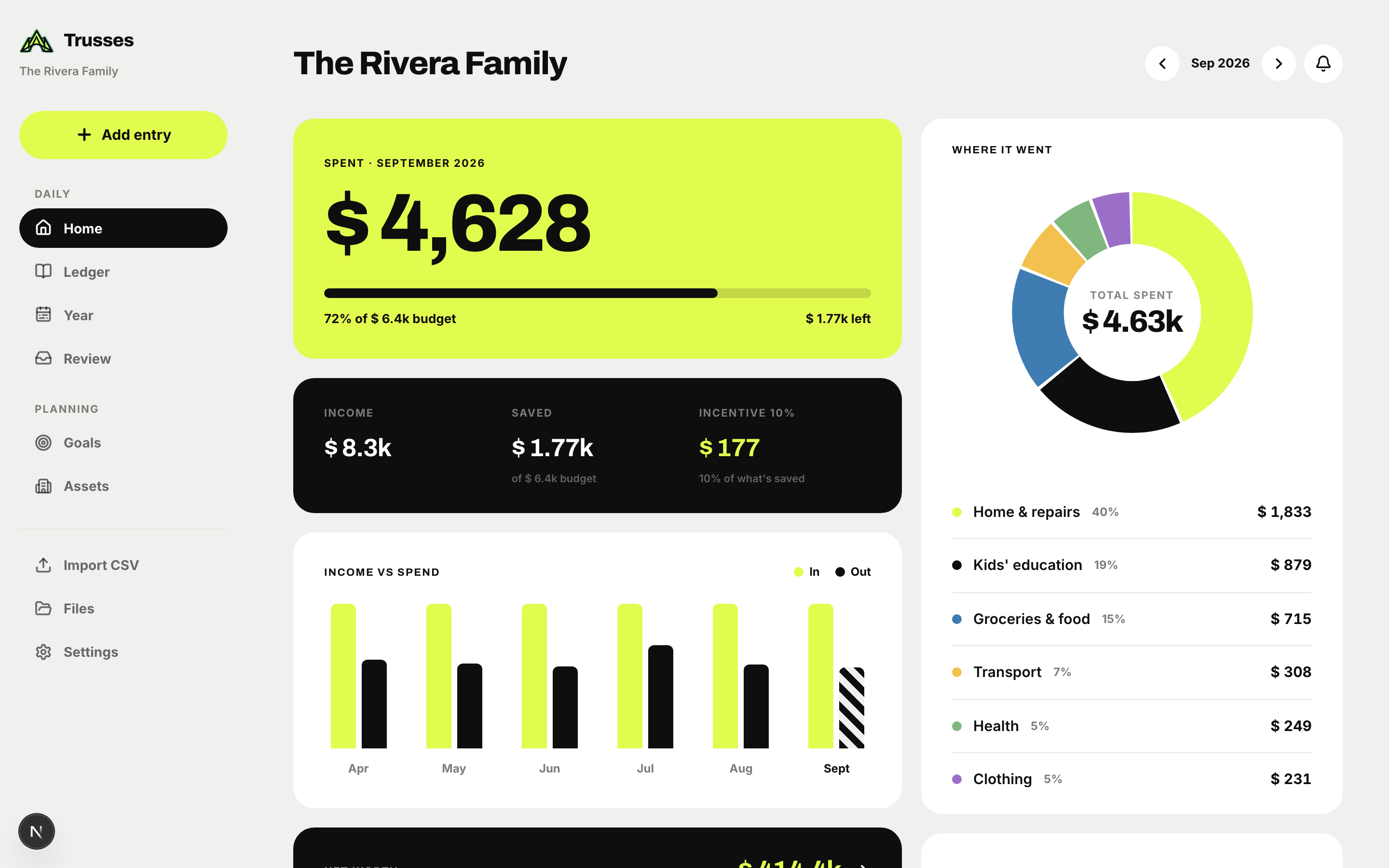
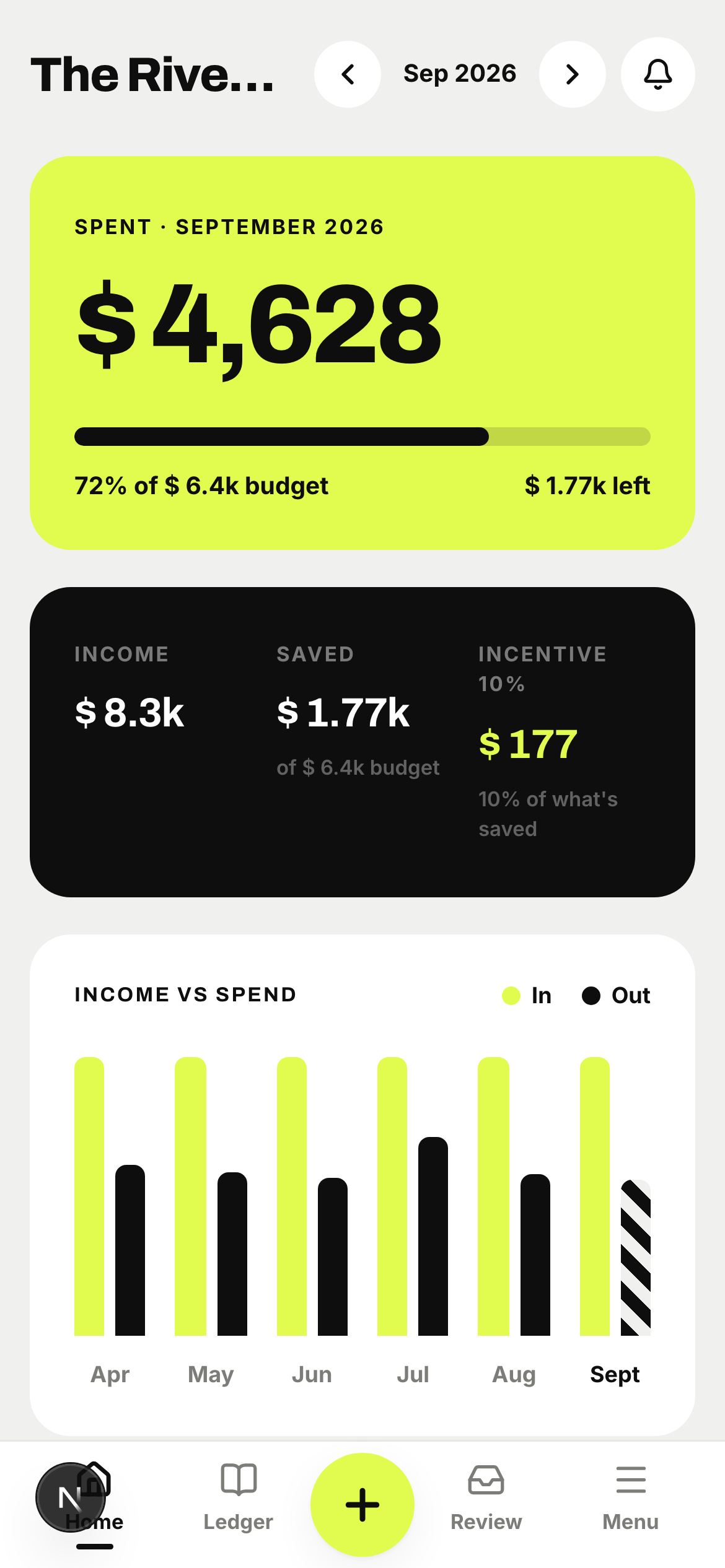
The month at a glance — spend against budget, what's saved, where it went.
58
rows in the statement we tested this on. All 58 imported, balance matched to the rupee.
90
days before it starts asking you to revalue an asset.
2
people is all this is built for. Three or four works. Fifty does not.
The part nobody else has
“What was this one?”
Whoever is doing the categorising hits a row they can’t place. A card charge, no merchant name, three weeks ago. In a spreadsheet that becomes a text message, then a conversation at dinner, then a guess.
Here it becomes a question attached to the transaction. The other person answers when they get to it. The answer stays on that row permanently, so in eleven months when you both wonder what it was, the row already says.
Answer the three below. Tick “remember as a rule” and that shop never gets asked about again.
3 waiting
Online purchase
14 Sep · Card ending 4471
Asked
What was this one? I can't place it.
Pay the person who does it
This is real work. It should be paid like it.
Household admin is usually invisible labour. One person does hours of it every month and the thanks is that nobody notices when it’s done well.
So Trusses has a number built into it. Set a monthly budget and a percentage. Whatever comes in under budget is the saving, and that percentage of it belongs to whoever keeps the book. It shows up on the dashboard next to the savings figure, calculated, every month, without anyone having to ask.
Ten percent is the default. It is your household, so make it whatever you both think is fair.
A month, worked through
- Budget
- 6,400
- Actually spent
- 4,628
- Saved
- 1,772
- Their 10%
- 177
Reimbursed bills and transfers between your own accounts are left out of the spend figure, so the saving is not inflated by money that was never gone.
The question a ledger usually dodges
When do we actually get the car?
Every budgeting app will show you a goal filling up. Almost none will tell you the date it finishes, because that means committing to a number.
Trusses takes the last three complete months of what you actually saved, takes the middle one so a single wedding or Eid does not skew it, and divides. If you set a deadline it will also say plainly when the pace will not make it, and how much more a month closes the gap.
It uses the same saving figure the incentive is paid on. The date and the cut are two views of one number, so neither can flatter the other.
Kitchen renovation
- Saved each month
- 1,390
- Still to go
- 3,000
- Finishes
- Dec 2026
Five months inside the May 2027 deadline. Had it been the other way round, this would say so instead — and name the monthly figure that fixes it.
Table stakes, done properly
The rest of it.
Import the statement
Export the CSV your bank already offers and drop it in. Rows you have seen before are fingerprinted and skipped, so importing the same file twice does nothing. Reversal pairs cancel each other out. At the end it checks its own total against the opening and closing balance printed on your statement, and tells you if they disagree.
Rules you taught it
Answer a question once, tick remember, and that merchant files itself from then on. Most households get to a handful of questions a month within two statements.
Whose spending was it
Tag a row to one person, or leave it with the household where it belongs. Useful when the kids' costs start mattering and nobody can remember what the year actually looked like.
Goals become assets
Save up for the car. When the goal completes it turns into an asset with the purchase price on it, so the thing you bought carries on counting toward net worth instead of vanishing from the books the day you paid for it.
What things are worth now
Assets keep a value history, not just what you paid. After 90 days without a fresh valuation the dashboard says so, because a net worth built on three-year-old numbers is worse than no number.
We never see your bank
There is no bank connection here. You export the file, you upload it. That is a slightly slower Sunday and a permanently smaller problem: no credentials of yours exist for anyone to lose, and nothing in this app has the power to move a rupee.
One book per household
One book, one household.
Sign up and you get your own book. Your accounts, your categories, the people in your house, your history. Another family signing up tomorrow gets theirs, and the two never touch — every query in this app is filtered by household before it returns a single row.
What we promise
- Every query is scoped to your household before it returns anything
- No bank credentials, because there is no bank connection
- Invite the people you share money with, as owner or member
- Add to Home Screen and it behaves like an installed app
Start with one statement.
Set a budget, import last month, and answer the handful of questions it comes back with. You will know where the month went before the tea goes cold.